If you run a small creative agency, plan on spending somewhere between $870 and $4,300 a month on accounting, and don't be surprised when the quotes you collect look nothing alike. That works out to $200 to $1,000 a week. Clean books and monthly reports sit at the low end. Full outsourced accounting with payroll and a monthly close lands in the middle, and fractional CFO guidance on margins and cash flow costs the most.
Hours are only part of the price. An accountant who works with agencies has to keep up with retainers, project budgets, freelancer payments, and the pass-through costs you bill back to clients, and most small businesses deal with none of that. So accountants for creative agencies tend to quote differently than a generalist would. It's also why the lowest quote usually leaves your most important question unanswered: which clients actually make you money?
We hear some version of it on intro calls every month. Revenue is up, cash is tight, and the owner can't say which accounts are profitable. Two retainers have run over scope for a year, and nobody caught it because the books only tracked totals.
If you've already read our guide on how to choose a virtual accounting service, this one picks up where it left off, with the numbers.
TL;DR Quick Answers
Accountants for Creative Agencies
Accountants for creative agencies track profit by client and project, not just in total. They watch time, utilization, retainer burn, and scope, so owners can see which work makes money and where margin is slipping. At Accountix, bookkeeping starts at $200 a week and outsourced accounting at $350 a week.
What they handle:
Job costing against each project budget
Retainer burn rates and unbilled work
Pass-through costs kept separate from fee revenue
Freelancer payments, W-9s, and 1099-NEC filing
Cash flow forecasts mapped against pipeline and payroll
What to ask before you hire one:
Can you show profitability by client or project?
Will you connect our time-tracking tool, such as Harvest, to the books?
Is tax filing in scope, or will we need a separate CPA?
How Much Does an Accountant Cost for a Small Creative Agency?
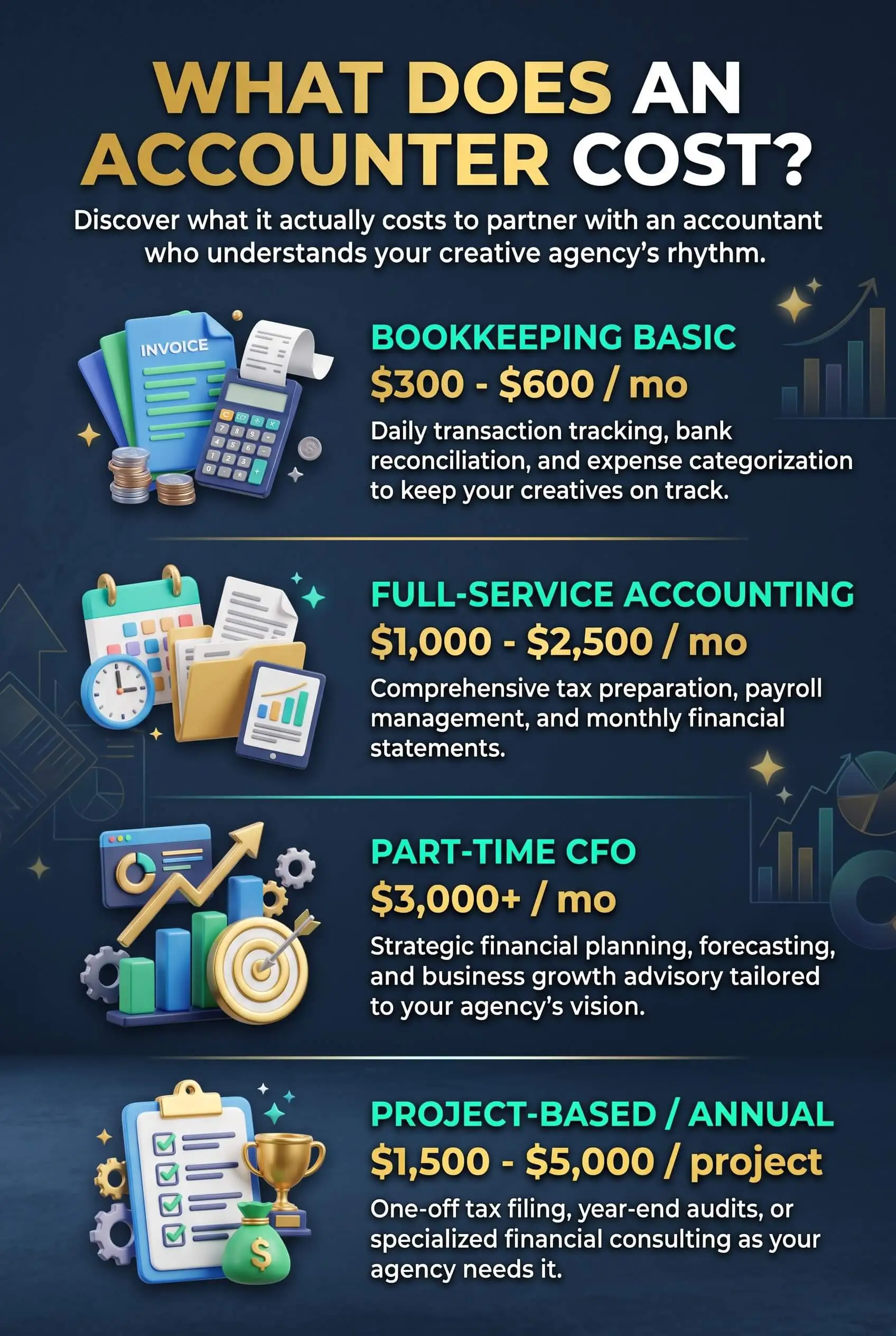
Most small creative agencies spend $200 to $1,000 a week on accounting, or about $870 to $4,300 a month. Bookkeeping sits at the low end and outsourced accounting with payroll and a monthly close falls in the middle, with fractional CFO support at the top. Job costing and contractor payments push agency costs up.
What Changes the Price?
Service level matters most. After that, transaction volume, client count, and the number of freelancers you pay all add work, and so do retainer tracking, job costing, pass-through billing, and payroll in more than one state. Books that are months behind need paid cleanup before regular service starts.
Is a Specialist Worth It Compared With an In-House Hire?
For most agencies with staff and retainers, yes. A bookkeeper at the BLS median of $50,670 a year costs more than basic outsourced service and brings one person's skills. Agency specialists track margin by client, and that matters when Promethean Research puts typical agency net margins between 13% and 19%.
How Should an Agency Choose an Accountant?
Ask for a sample monthly report and check that it shows profitability by client or project. Find out the close date, who reviews the work, and whether tax filing is included. Then confirm CPA credentials on CPAverify and call a couple of references from creative agencies close to your size.
Top Takeaways
Budget $200 to $1,000 a week. Bookkeeping starts around $200 a week and outsourced accounting around $350, while fractional CFO support runs $350 to $750 or more.
Agency work takes more accounting. Retainers, project budgets, contractors, and pass-through costs add work that a typical small business never has.
Compare against the in-house option. A bookkeeper at the BLS median of $50,670 a year covers one person's hours, and benefits and software cost extra.
Ask to see profitability by client. A provider who can't show margin by client or project is selling you records rather than visibility.
Thin margins make a specialist pay off. When net margins sit between 13% and 19%, catching one over-scope retainer early can cover a year of accounting.
What Drives the Cost of an Accountant for a Creative Agency?
Two agencies with the same revenue can get quotes thousands of dollars apart. The gap usually comes down to how much work sits behind each dollar you bill. These are the drivers we see move the price most:
Transaction volume and client count. Every client adds invoices to send and payments to reconcile, so thirty small accounts take more time than five large ones.
Retainers versus project billing. Retainers need burn rates tracked month to month. Fixed-fee projects need time and costs checked against the budget, or scope creep quietly erodes the margin.
Job costing and time tracking. Connecting Harvest or QuickBooks Time to your books is what makes project margins visible, and someone has to set that up and keep it clean.
Freelancers and contractors. Collecting W-9s, running payments on schedule, and filing 1099-NEC forms at year-end all add hours.
Pass-through costs. Media spend, printing, and production you bill back to clients inflate your top line. Left mixed in with agency fees, they make your margins look healthier than they are.
Payroll across states. Each new state means another registration and another set of filings.
Cleanup. Books that are months behind cost more to fix once than to keep current.
You probably price your own services by working out what an hour really costs you. The same logic applies here, and our breakdown of how to calculate agency costs walks through it.
Creative Agency Accountant Cost by Service Level
The level of support you buy matters more than any single driver above. Here's how it breaks down at Accountix, with pricing last reviewed in October 2026:
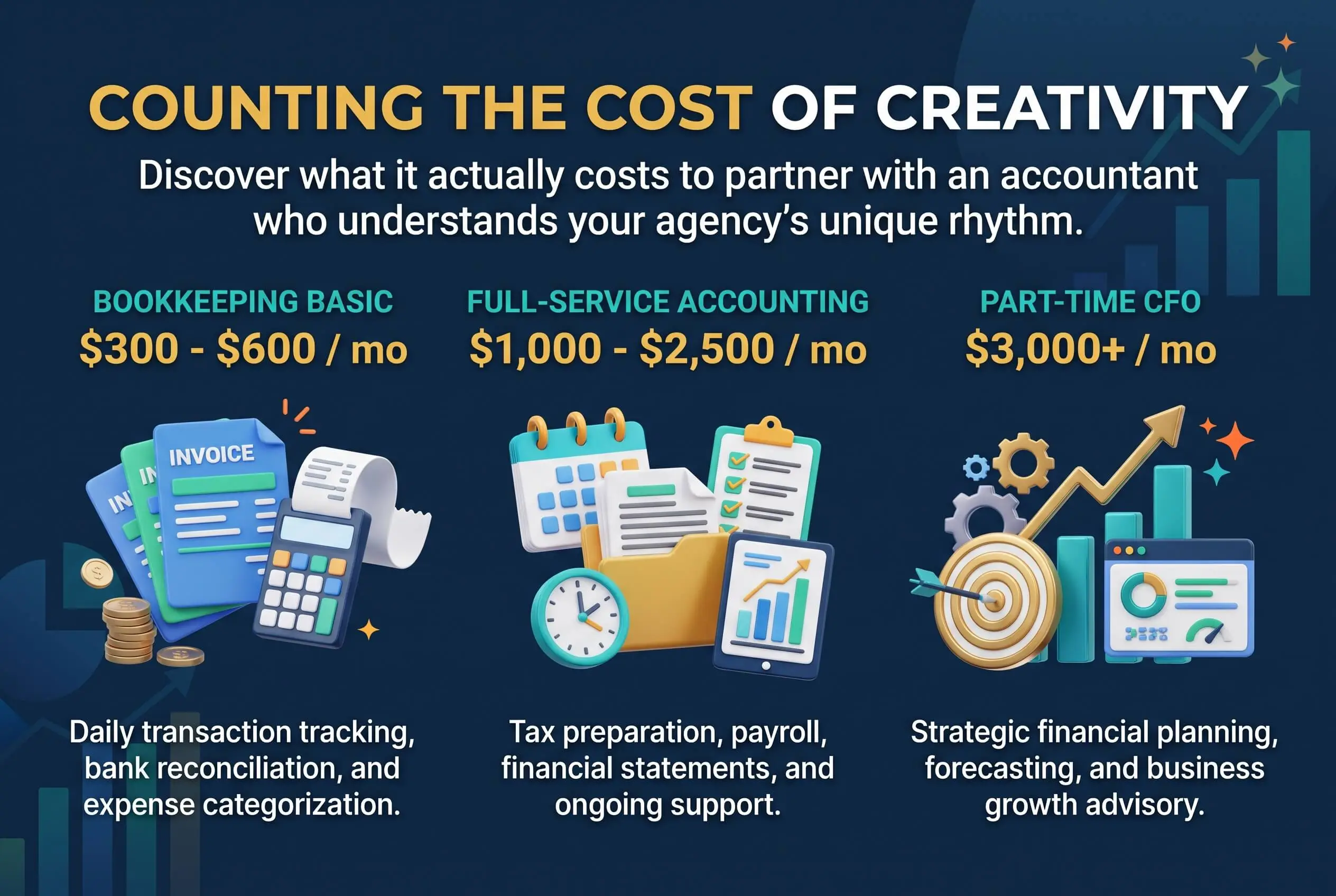
Bookkeeping, starting at $200/week. Covers transaction entry, reconciliations, monthly reporting, and quarterly reviews. Best for studios under $2M in annual revenue.
Outsourced accounting, starting at $350/week. Covers weekly bookkeeping and AP/AR, payroll, and a monthly close with a review meeting. Best for agencies earning $1M to $3M.
Fractional CFO, $350 to $750/week. Covers project costing, margin assessments, and cash flow forecasting. Best for agencies at $2M and up that are planning hires or growth.
Treat those as starting points. We set final pricing after a discovery call, once we've seen your transaction volume, how many contractors you pay, and where the books stand.
For comparison, the Bureau of Labor Statistics puts the median bookkeeper's pay at $50,670 a year, and benefits, payroll taxes, and software come on top of that. That salary buys one person's hours. It won't buy a monthly close that still happens when they're on vacation, or someone who can show you which retainers lose money.
What Accountants for Creative Agencies Do Differently
Standard bookkeeping tracks the basics and tells you where the money went. For a creative firm, profit comes down to time, utilization, project performance, and how well you hold scope.
Getting at those numbers takes a different setup. Specialized accountants for creative agencies track time and costs against each project budget and watch retainer burn rates month to month. They flag unbilled work before it slips past invoicing, and they pull pass-through costs out of fee revenue so your margin figures hold up.
Here's a composite of a story we hear often. A nine-person design studio grew revenue 20% in a year and ended it with less cash in the bank. Job costing showed why within the first month. Its two largest retainers were running 30% to 40% over scope, and nobody had repriced either one since it was signed. The owners raised both at renewal, and one of the two clients stayed. [VERIFY]
Specialist support isn't for everyone. A solo designer with a handful of clients and simple invoices can get by with good software and a tax preparer in the spring. Add staff, retainers, and contractors, and the math shifts.
Is a Specialist Accountant Worth the Cost?
For most agencies past the solo stage, yes, and thin margins are the reason. Promethean Research found the average digital agency kept a 13% net margin in 2025, with the smallest studios at 19%. At those levels, one retainer running over scope can cancel out the profit from several healthy accounts.
Put it in dollars. A $10,000-a-month retainer that runs 20% over scope leaves about $24,000 a year in unbilled work on the table, which is more than a year of basic bookkeeping. What you're paying a specialist for is catching that retainer in month two instead of month twelve.
If you're not sure your own rates cover your costs, our guide on what a marketing agency should charge is a good place to start.
"I ask every agency owner the same thing on our first call: which three clients made you the most money last quarter? Hardly anyone can answer without opening a spreadsheet. The ones who try usually name their biggest clients, and those are rarely the most profitable. When we set up job costing for a creative firm, the first month of real numbers almost always surprises someone. A favorite retainer turns out to be breaking even, while a small project client has been quietly carrying the margin. Once owners can see that, they stop guessing at pricing and start making calls they can defend to their team."
7 Essential Resources
Owners who know the basics get more out of any accountant, and they spot a weak one faster. These are the resources we send agency owners to before they hire anyone.
1. IRS: Independent Contractor (Self-Employed) or Employee?
Most creative agencies lean on freelancers, and misclassifying one can leave you owing back employment taxes. The IRS weighs behavioral control, financial control, and the type of relationship. Read this before you bring on your next long-term contractor. IRS: Independent contractor or employee?
2. IRS: About Form 1099-NEC
You'll file this form for the contractors you pay during the year. The IRS page keeps the current form and instructions in one place, and it's worth a look each January since reporting rules and deadlines can change. About Form 1099-NEC, Nonemployee Compensation
3. IRS Publication 583: Starting a Business and Keeping Records
This is the IRS's plain-language guide to recordkeeping, accounting methods, and the taxes a small business owes. We like its recordkeeping section because it works as a checklist for what your accountant should be maintaining. IRS Publication 583
4. CPAverify
If a provider tells you a CPA reviews your books, check. CPAverify pulls license data from state boards of accountancy into a single search and shows any disciplinary actions. It takes about a minute. CPAverify.org
5. IRS: Choosing a Tax Professional
Plenty of outsourced accounting firms don't prepare tax returns, so you may still need a separate preparer. The IRS explains the different credentials here and links to its directory of preparers who hold them. IRS: Choosing a tax professional
6. IRS: S Corporations
"Should we be an S corp?" comes up with agency owners more than almost any other tax question. This page lays out the eligibility rules and filing requirements, so you can walk into that conversation with your accountant already knowing the basics. IRS: S corporations
7. BLS Occupational Outlook Handbook: Accountants and Auditors
When you're weighing an in-house hire against an outside team, it helps to know what the role involves, which credentials are typical, and what it pays. BLS covers all of it. BLS: Accountants and Auditors
3 Statistics
When an agency owner is deciding what kind of accounting support to pay for, these are the numbers we put in front of them.
Stat 1: The Median Bookkeeper Earns $50,670 a Year
Key findings:
The median annual wage for bookkeeping, accounting, and auditing clerks was $50,670 in May 2025
BLS projects a 6% decline in these jobs from 2025 to 2035 as software takes over routine data entry, and expects the remaining work to lean more toward analysis
The Accountix perspective: For most small agencies, that salary buys data entry before you've paid a dollar in benefits or software. The job costing and retainer tracking that protect your margins aren't part of it. Analysis is where BLS sees the work heading, and it's exactly what creative firms need most.
Stat 2: Studio Agencies Average a 19% Net Margin, While the Average Agency Earned 13%
Source: Promethean Research, 2026 State of Digital Services Report
Key findings:
Average agency net margins slipped to 13% in 2025
Studio shops, the smallest agencies in the survey, led again with a 19% net margin
Promethean's profitability benchmarks put the long-run average since 2015 at about 15%
The Accountix perspective: Small studios can be among the most profitable shops in the industry, as long as they know where the profit comes from. With margins in that range, a single retainer running over scope can erase the gains from several healthy accounts. We'd call that the strongest argument for accounting that tracks profitability client by client.
Stat 3: 38% of Skilled U.S. Knowledge Workers Now Freelance
Source: Upwork, Future Workforce Index 2026
Key findings:
Skilled freelancers make up 38% of U.S. knowledge workers, up from 28% a year earlier
Upwork surveyed 2,400 U.S.-based skilled workers in March and April 2026
The Accountix perspective: Creative agencies already build teams around freelancers, and that talent pool is getting bigger. Each new contractor brings a W-9, a spot in the payment run, a 1099 at year-end, and sometimes a classification question. It's a big part of why accounting for a creative agency costs more than it does for a business with a fixed staff.
Final Thoughts and Opinion
Years of cleaning up books for creative firms have taught us that the cheapest accountant is rarely the cheapest outcome for an agency.
The story usually goes the same way. An owner takes the lowest quote, and for a while nothing looks wrong. The books are clean and the taxes get filed. Nobody is tracking time against project budgets or watching retainer burn, though, so revenue grows and the bank balance doesn't. Figuring out why can take a year or more, and by then the lost margin is far bigger than the gap between the two quotes ever was.
Our advice is to buy the support that matches the questions you're asking. If you need clean records and an easy tax season, bookkeeping will do. If you want to know which clients are profitable, whether you can afford the next hire, or why cash runs short in strong months, you need accountants for creative agencies who can answer with your own numbers.
One caveat we think every provider should share up front. Many outsourced firms, Accountix included, focus on bookkeeping, accounting, and financial strategy rather than tax preparation. Ask each provider whether filing is in scope or whether you'll keep a separate CPA, and get that answer before you sign.
Frequently Asked Questions
How much does an accountant cost for a small creative agency per month?
Most small creative agencies pay roughly $870 to $4,300 a month. Bookkeeping alone starts around $200 a week, and full outsourced accounting with payroll and a monthly close starts around $350. Fractional CFO support costs more. Your transaction volume, contractor count, and any cleanup work set the final price.
Do creative agencies need a CPA, or is a bookkeeper enough?
A bookkeeper is enough if you need clean, tax-ready records. When you need project margins, cash flow forecasts, or help deciding on pricing and hires, you've outgrown bookkeeping and need accounting or CFO-level support. Many agencies also keep a separate CPA for tax returns, so ask what each provider covers.
What do accountants for creative agencies do that a general accountant doesn't?
They track profitability by client and project instead of just totals. In practice that means job costing, watching retainer burn rates, flagging unbilled work, and separating pass-through costs from agency fees. They're also used to contractor-heavy teams, so 1099s and classification questions are routine for them.
Is outsourced accounting cheaper than hiring in-house?
For most small agencies, yes. A median bookkeeper earns $50,670 a year before benefits, and you get one person's skill set for that money. An outsourced team often costs less, and you get specialists in payroll and reporting plus coverage when someone is out.
How do accountants handle freelancer and contractor payments for agencies?
A good agency accountant collects a W-9 before the first payment goes out, pays contractors on a set schedule, and files 1099-NEC forms at year-end. They should also tag each contractor cost to the right client or project, so you can see what every engagement costs to deliver.
When should a creative agency hire a fractional CFO?
Hire one when big decisions start running on guesswork. Cash getting tight in strong months is a common sign, and so is not knowing whether you can afford the next hire or suspecting some retainers are underpriced. Our fractional CFO support is built for agencies from about $2 million in revenue and up.
Get Clear on What Your Agency's Numbers Are Telling You
You shouldn't have to guess which clients are profitable or why cash gets tight in a good month. If you'd like to know what professional accounting services would cost for your agency, book a 30-minute intro call with Accountix. We'll look at where your books stand and how you bill, then tell you what level of support fits. No sales pitch. Just clarity.


