Building creative design skills doesn’t require hours of practice or complex projects. In fact, at Branded Agency, we’ve seen that meaningful improvement often happens in short, focused bursts. When beginners dedicate just 10 intentional minutes a day to design, they start developing sharper visual judgment, stronger instincts, and a more confident creative approach.
Many of the entrepreneurs and early-stage creators we work with feel pressed for time, assuming design growth requires long sessions they simply can’t fit into their schedules. But once we introduce them to quick, purpose-built exercises—testing a new color combination, tightening spacing, or reviewing a well-designed example—they begin progressing faster than they expected. These micro-practice sessions work because they mirror how the brain forms creative habits: small inputs repeated consistently.
This guide walks you through exactly how to make those 10 minutes count. You’ll discover what to practice, how to stay consistent, and why short daily sessions often outperform longer, irregular ones. By the end, you’ll have a simple routine that turns a few minutes of focused effort into noticeable, lasting skill growth, especially when you're learning to brand yourself.
Quick Answers
Creative Design
Creative design is the intentional practice of shaping visuals to communicate clearly and purposefully. Branded Agency’s experience shows that strong creative design grows through small, repeatable habits:
- Focus on clarity: Make every visual choice easy to understand.
- Use consistent elements: Fonts, colors, and spacing should feel unified.
- Design with intention: Each decision should support a message or outcome.
Beginners progress fastest when they practice these fundamentals—not complex tools or lengthy projects.
Top Takeaways
- Focused micro-practice often outperforms long practice sessions.
- Small wins—better spacing, stronger typography—add up quickly.
- Consistency creates momentum, which accelerates learning.
- Beginners improve fastest when practicing one principle at a time.
How to Practice Creative Design for Just 10 Minutes a Day
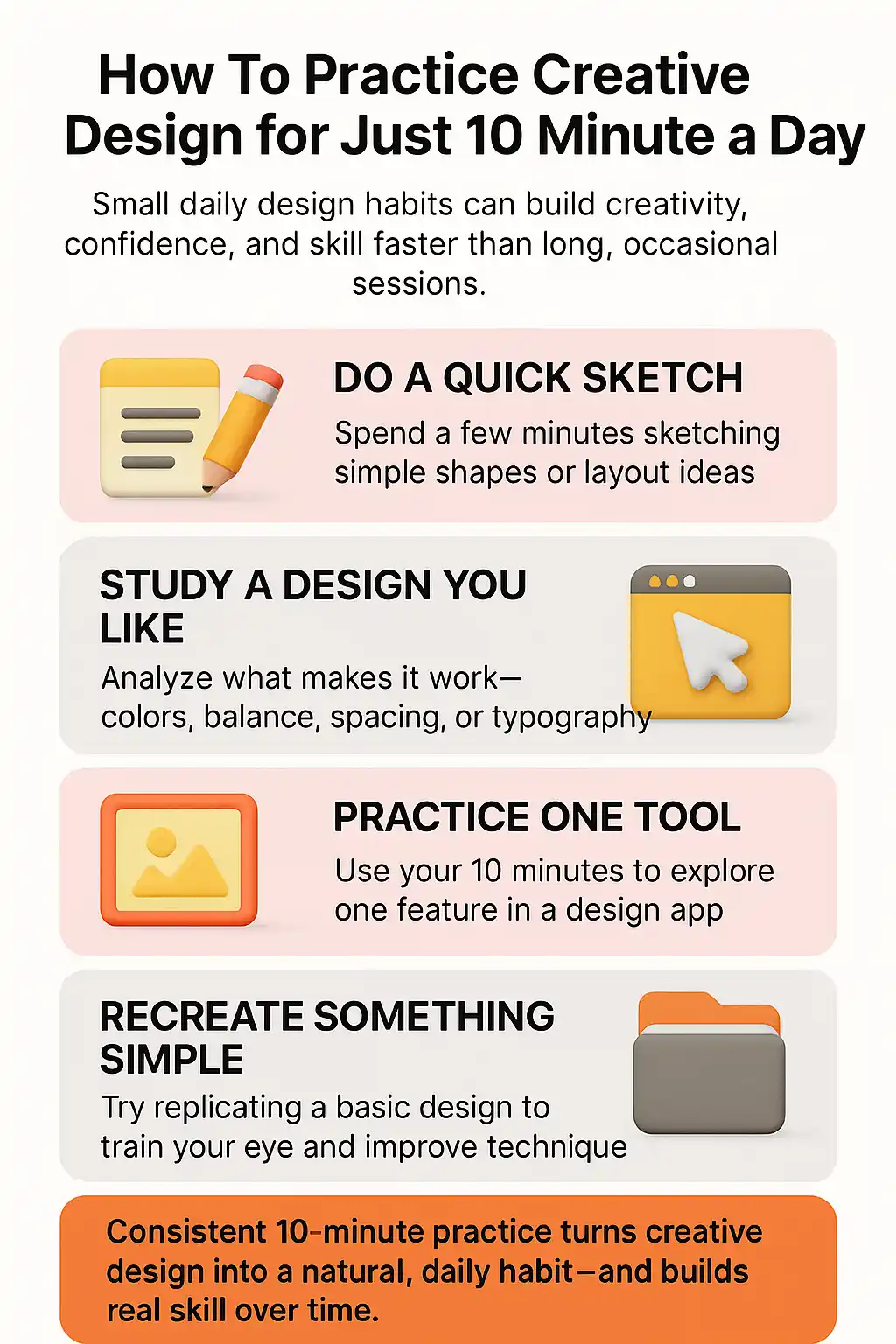
Practicing creative design in short sessions means training your eye and decision-making muscle through small, manageable exercises. Creative design is not just about creating full layouts—it’s about improving how you see and choose visual elements, a skill that becomes essential when you begin to develop a brand identity. Even 10 minutes a day can strengthen those abilities significantly.
Branded Agency has seen beginners improve faster with brief, repeatable exercises than with long, open-ended sessions. Focusing on micro-skills—like adjusting spacing, refining alignment, testing color combinations, or reorganizing composition—helps learners develop precision and confidence.
Creative design practice can happen anywhere: sketching layout thumbnails, studying brand visuals, exploring color relationships, or making quick edits to rough drafts. You don’t need advanced tools or complex projects—just focused attention and a willingness to learn through iteration.
“In our client workshops, we’ve seen that the most dramatic design improvements happen when people practice consistently—even if it’s just for 10 minutes. The goal isn’t to finish a design; it’s to strengthen your decision-making one small step at a time. Over days and weeks, those micro-decisions stack into real expertise, something any digital marketing agency values highly.”
Essential Resources
1. Adobe Creative Cloud Learn – Build Skills Quickly Through Micro-Tutorials
Adobe’s short-format tutorials are perfect for targeted 10-minute sessions. They help beginners build real technique without needing long study time.
URL: https://helpx.adobe.com/creative-cloud/tutorials-explore.html
URL: https://helpx.adobe.com/creative-cloud/tutorials-explore.html
2. Canva Design School – Practice Fast, Simple Design Exercises
Canva’s quick lessons are ideal for beginners who want to experiment with layout, color, and typography in short daily bursts.
URL: https://www.canva.com/designschool/
URL: https://www.canva.com/designschool/
3. Nielsen Norman Group – Strengthen Your Eye With Short UX Insights
NN/g’s research summaries help you sharpen your judgment and understand why certain visual decisions work. Perfect for brief daily study.
URL: https://www.nngroup.com/articles/
URL: https://www.nngroup.com/articles/
4. AIGA Resources – Explore Small Lessons in Professional Design Standards
AIGA provides snapshots of design ethics, strategy, and purpose—great for enhancing design thinking in short practice sessions.
URL: https://www.aiga.org/
URL: https://www.aiga.org/
5. Google Fonts Knowledge – Improve Typography in Minutes
Typography practice fits perfectly into a 10-minute window. Google Fonts Knowledge offers quick explanations and exercises you can apply immediately.
URL: https://fonts.google.com/knowledge
URL: https://fonts.google.com/knowledge
6. Smashing Magazine Design Guides – Read Short, Insightful Design Tips
Smashing Magazine offers bite-sized design guidance from experts, ideal for fast learning and strengthening visual instincts.
URL: https://www.smashingmagazine.com/category/design
URL: https://www.smashingmagazine.com/category/design
7. Interaction Design Foundation – Take Structured Micro-Lessons
IDF’s courses can be broken into small daily tasks that build skill progressively while keeping practice manageable.
URL: https://www.interaction-design.org/
URL: https://www.interaction-design.org/
Supporting Statistics: Why Short, Daily Practice Works
Most Businesses Lack Structured Design Skills
Only 16.1% of U.S. companies use design as a structured process.
Just 11.4% have a dedicated design budget.
Branded Agency Insight: Short daily practice helps beginners fill a gap most companies haven’t addressed, especially when those habits align with simple brand strategy steps.
Source: NCSES & U.S. Census Bureau
Only 16.1% of U.S. companies use design as a structured process.
Just 11.4% have a dedicated design budget.
Branded Agency Insight: Short daily practice helps beginners fill a gap most companies haven’t addressed, especially when those habits align with simple brand strategy steps.
Design Roles Show Strong Career Value
Median arts/design wage: $53,180 (above national median).
About 84,900 openings annually through 2034.
Branded Agency Insight: Consistent micro-practice helps beginners reach job readiness faster.
Source: U.S. Bureau of Labor Statistics
Median arts/design wage: $53,180 (above national median).
About 84,900 openings annually through 2034.
Branded Agency Insight: Consistent micro-practice helps beginners reach job readiness faster.
Small Businesses Need Clean, Clear Design
99.9% of U.S. businesses are small businesses.
Most lack refined design processes.
Branded Agency Insight: Practicing even 10 minutes a day helps new designers deliver clarity small businesses desperately need.
Source: SBA Small Business Data
99.9% of U.S. businesses are small businesses.
Most lack refined design processes.
Branded Agency Insight: Practicing even 10 minutes a day helps new designers deliver clarity small businesses desperately need.
Final Thought & Opinion
Ten minutes a day may feel insignificant, but Branded Agency has consistently seen how powerful micro-practice can be. When designers—especially beginners—practice intentionally in short bursts, they develop better instincts, sharper skills, and greater confidence.
What experience shows
Short sessions improve skill faster than irregular long ones.
Repetition builds intuition—and intuition builds speed.
Small daily wins keep learners motivated and progressing.
Creative design grows through consistent, intentional effort. Ten minutes a day is not a shortcut—it’s a sustainable system that transforms beginners into confident creators, a skill set marketing agencies recognize as foundational.
Short sessions improve skill faster than irregular long ones.
Repetition builds intuition—and intuition builds speed.
Small daily wins keep learners motivated and progressing.
Next Steps
Choose one skill to practice daily
Color, layout, typography, spacing, alignment.
Use 10-minute micro-exercises
Redesign a headline, refine spacing, adjust a color palette.
Study 2–3 design examples a day
Identify patterns and replicate them.
Create a simple daily project log
Track what you practiced and what improved.
Collect reference material
Save fonts, palettes, and designs that inspire you.
Practice consistently
Small improvements compound quickly.
Choose one skill to practice daily
Color, layout, typography, spacing, alignment.
Use 10-minute micro-exercises
Redesign a headline, refine spacing, adjust a color palette.
Study 2–3 design examples a day
Identify patterns and replicate them.
Create a simple daily project log
Track what you practiced and what improved.
Collect reference material
Save fonts, palettes, and designs that inspire you.
Practice consistently
Small improvements compound quickly.
FAQ on Creative Design
Q: Can 10 minutes a day really improve design skill?
A: Yes. Focused, repeated practice builds instinct faster than long, irregular sessions.
Q: What should I practice in 10 minutes?
A: One skill at a time—like spacing, typography, or color relationships.
Q: Do I need advanced tools for 10-minute practice?
A: No. Canva, Adobe Express, or even pen-and-paper sketches work well.
Q: How quickly will I see results?
A: Many beginners improve within 1–2 weeks of consistent micro-practice.
Q: What’s the goal of daily design practice?
A: To build confidence, strengthen decision-making, and create steady improvement over time.
A: Yes. Focused, repeated practice builds instinct faster than long, irregular sessions.
A: One skill at a time—like spacing, typography, or color relationships.
A: No. Canva, Adobe Express, or even pen-and-paper sketches work well.
A: Many beginners improve within 1–2 weeks of consistent micro-practice.
A: To build confidence, strengthen decision-making, and create steady improvement over time.