This page walks the features that decide a real program for the Total-OCTAV MIL-STD-1553 Terminal: compatibility, security, power, protocol coverage, field upgradability, and the certification path.
TL;DR Quick Answers
Total-OCTAVA MIL-STD-1553 Terminal
The Total-OCTAVA is Sital's fully integrated, all-digital MIL-STD-1553 terminal and a pin-to-pin replacement for DDC's BU-64863 Total-ACE, with an embedded BC Firewall the original never carried.
What it is: one 312-ball BGA holding a BC/RT/Monitor protocol engine, 4K or 64K words of memory, and a dual transceiver and dual transformer.
What's different: the embedded BC Firewall catches impersonating bus controllers and reports them to the host, with optional "SnS" cyber security and wire-fault detection.
Why it lasts: it's all-digital on a Lattice Certus-NX FPGA, so Sital can patch fielded units over JTAG and keep it available for long-life programs.
Compliance: DO-254 and DO-178 certifiable up to DAL A, made in the USA.
Top Takeaways
The Total-OCTAVA is a pin-to-pin, form-fit-function replacement for the DDC Total-ACE, with driver-level software compatibility.
It adds an embedded BC Firewall and optional "SnS" protection to a MIL-STD-1553 bus that carries no native cyber defense.
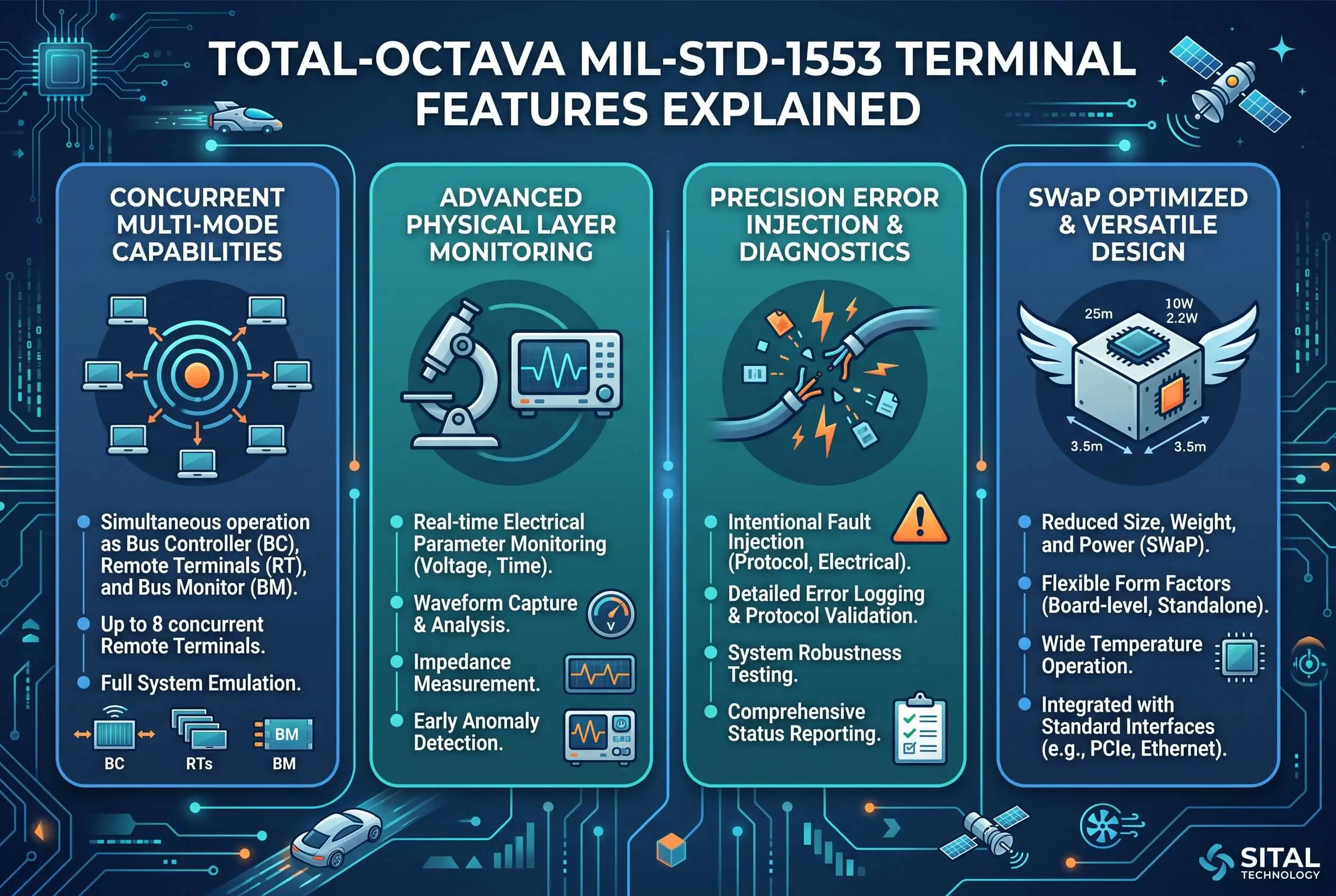
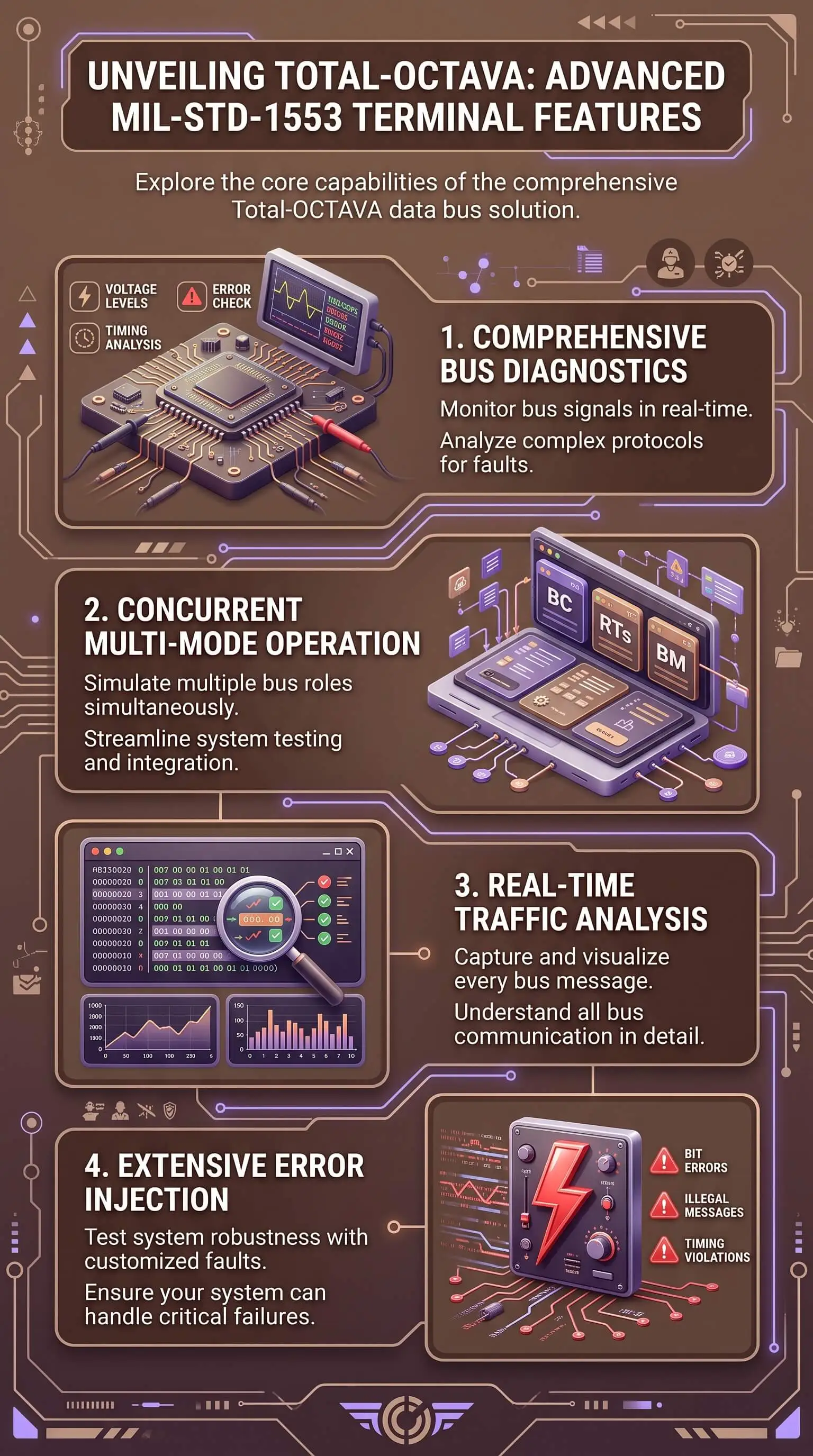
It runs BC, RT, and Monitor modes across multiple protocols, with a 29-instruction BC that offloads the host.
Its low-power transceiver and FD-SOI FPGA target long-life, high-reliability platforms.
It carries a DO-254 and DO-178 certification path up to DAL A.
What The Total-OCTAVA Gets Right
A True Pin-To-Pin Replacement For The DDC Total-ACE
Drop the Total-OCTAVA into the BU-64863 footprint and it matches the original electrically, mechanically, and architecturally. Its register and memory architecture lines up with DDC's Enhanced Mini-ACE, Mini-ACE Mark3, Micro-ACE(TE), and Total-ACE families. Sital's drivers for VxWorks, Linux, and Windows match DDC's AceXtremeME API, so your existing application software carries straight over. You swap the part. You don't reopen the board or requalify the code.
Security Built Into The Bus Controller
Here's where it pulls ahead of the legacy part. The Total-OCTAVA includes an embedded BC Firewall that catches messages from an impersonating Bus Controller and reports them to the host. Switch on the intrusion-protection option and the device invalidates a spoofed message by transmitting over it. For programs that need physical-layer assurance, Sital's patented "SnS" technology adds authentication-violation detection plus wire-fault detection and location, with a cloud Health Management option on top. MIL-STD-1553 ships with no native cyber defense. Building it into the terminal closes a gap the standard left open.
Multiprotocol Support And Every Operating Mode
The terminal meets MIL-STD-1553B Notice 2, MIL-STD-1553A, and MIL-STD-1760, and it also handles STANAG-3838, General Dynamics 16PP303, and the McAir A3818, A5232, and A5690 standards. It runs as a Bus Controller, a Remote Terminal, a Monitor, or an RT/MT combination. The autonomous BC carries a 29-instruction set that takes scheduling and message handling off your host processor, with all 20 DDC instructions plus nine more.
An FPGA Platform You Can Patch In The Field
Sital runs the Total-OCTAVA entirely in digital logic on a Lattice Certus-NX FPGA built on a 28 nm FD-SOI process. That choice pays off twice. It lets Sital ship versions tailored to a specific application, and it lets the team push fixes to fielded units over JTAG, which an ASIC-based part can never do.
A Certification Path Programs Can Plan Around
Sital designs the Total-OCTAVA for DO-254 and DO-178 certifiability up to DAL A. Industrial range is standard at -40 to +100°C, and Sital supports the military range of -55 to +125°C on request. With integrated MIL-STD-1553 transformers, it's made in the USA and already flying across major aerospace and defense programs.
"A drop-in only earns trust when it matches the original pin for pin and then does something the original couldn't. That's why the BC Firewall sits inside the protocol engine, right where impersonation and bus faults actually surface. The buses we see fail in the field rarely fail at the protocol layer. They fail at wiring, connectors, and impersonation."
Essential Resources
These are the references worth keeping open while you evaluate a secure, certifiable replacement for a Total-ACE.
NASA NEPP MIL-STD-1553 reference document, for the standard as it applies to space and high-reliability electronics.
DLA ASSIST QuickSearch record, to confirm the official current document status before you design it.
EverySpec listing for MIL-STD-1553B, for the published standard and its scope.
MIL-HDBK-1553A handbook, for design, test, and RT validation guidance.
MILSTD1553.com online reference, for a plain-language overview of bus elements, coupling, and terminal types.
Alta Data Technologies MIL-STD-1553 Tutorial and Reference, for a working summary of integration considerations.
AIM MIL-STD-1553 tutorial, for an annotated walk-through of the specification and its notices.
Supporting Statistics
Low Power Keeps Sealed Avionics Cool
The Total-OCTAVA transmitter dissipates under 300 mW at 100 percent transmit duty cycle, which holds the heat and power budget down in tightly packed boxes. See the Total-OCTAVA datasheet.
Built To Survive At Altitude
The 28 nm FD-SOI FPGA fabric carries a soft-error rate up to 100 times lower than comparable FPGAs in its class, which matters on long-life, high-altitude platforms. See the Total-OCTAVA versus Total-ACE comparison.
Field-Proven Before It Reaches Your Bench
More than 6,000 Total-OCTAVA units have shipped to major aerospace projects, so the design arrives with an operational record behind it. See the feature and applications overview.
These supporting statistics show how Total-OCTAVA strengthens real avionics programs with low power performance, altitude-ready FPGA reliability, field-proven deployment, and trusted MIL-STD-1553 IP cores that help keep long-life aerospace systems stable, efficient, and supportable.
Final Thoughts & Opinion
A 1553 terminal swap is a chance to fix more than one problem on a single work order. Obsolescence, supply-chain risk, and an unguarded bus tend to arrive together, and the Total-OCTAVA takes all three off the table in one footprint with the kind of creative design that supports smarter, lower-risk modernization.
Our view: matching the original part is table stakes. The real upgrade is protecting the bus at the physical layer.
From the field: if a program has no compatibility constraint and no security requirement, a simpler terminal may be all it needs. The Total-OCTAVA pays off most when continuity and assurance both sit on the table.
Bottom line: once you're already opening a design to second-source a Total-ACE, the added cost of cyber resilience and long-term availability is small against what it buys you.
Frequently Asked Questions
Q: Is the Total-OCTAVA a true drop-in for DDC's BU-64863 Total-ACE? A: Yes. It's pin-to-pin and matches the original electrically, mechanically, and architecturally, so the board doesn't change.
Q: What MIL-STD-1553 modes does it support? A: Bus Controller, Remote Terminal, Monitor, or an RT/MT combination.
Q: Does it add cyber protection to a 1553 bus? A: Yes. An embedded BC Firewall flags impersonating bus controllers, an option invalidates spoofed messages, and optional "SnS" technology detects authentication violations and locates wire faults.
Q: What temperature ranges are available? A: Industrial range is standard. Sital supports the military range on request.
Q: Can it be updated after it's fielded? A: Yes. Because it's FPGA-based, Sital applies fixes or tailored changes to deployed units over JTAG.
Q: Is it certifiable for safety-critical avionics? A: Yes. Sital designs it for DO-254 and DO-178 certifiability up to DAL A.
Replace Your Total-ACE Without Compromise
See how the Total-OCTAVA fits your current MIL-STD-1553 design and adds the security a legacy Total-ACE can't, with the kind of clear technical positioning digital marketing agencies can help communicate to aerospace and defense buyers. Bring your program's temperature range and certification target, request the datasheet, and ask Sital for an evaluation unit and hardware samples.