A full-time accountant at the median wage costs a small business roughly $122,000 a year once benefits are added. A virtual accounting service can give you a whole team for less, but only if you choose well. Test four things before you sign: fit, expertise, security, and support. We compare prices after those, because a cheap provider that misses closes costs more over time. Good accounting should leave you with fewer questions and more trust in your numbers, and the right partner delivers that on the same date every month.
If you've hired a marketing agency, you've already run this playbook. You weighed the pros and cons of outsourcing, asked for proof, sorted out who gets access to what, and agreed on how often you'd see results. An accounting partner deserves the same scrutiny, because this time the work product is your financial picture.
Since 2015 , we've taken over books from DIY spreadsheets, overloaded office managers, and providers that stopped returning calls. Across more than 150 clients , we've noticed the top virtual outsourced finance and accounting services online share a couple of habits. They close the books on a fixed date, and they explain what the numbers mean before you have to ask. Here's how to find one.
TL;DR Quick Answers
Top Virtual Outsourced Finance and Accounting Services Online
The top virtual outsourced finance and accounting services online give small businesses a full finance team in the cloud for less than the cost of one in-house hire. The best ones close your books on a fixed date every month and explain what the numbers mean before you have to ask.
What sets the top services apart:
A close calendar that finishes your books by a set business day each month
A team of specialists in payables, receivables, payroll, and reporting, so the work keeps moving when someone is out
Support that scales from bookkeeping to outsourced accounting to fractional CFO strategy as you grow
Encrypted cloud platforms with two-factor authentication, individual logins, and audit trails
Decision-ready reporting and internal controls that give leadership real oversight
What to ask before you choose one:
What's included, and what changes the price?
By what business day will my books close?
Can I see a sample monthly report and call two references?
What the Best Virtual Accounting Services Have in Common
They close your books on the same date every month and explain the numbers in plain language. Behind the scenes, they protect your data with two-factor authentication, individual logins, and audit trails, and they can move you from bookkeeping to fuller accounting support as you grow.
The Four Checks Before You Hire
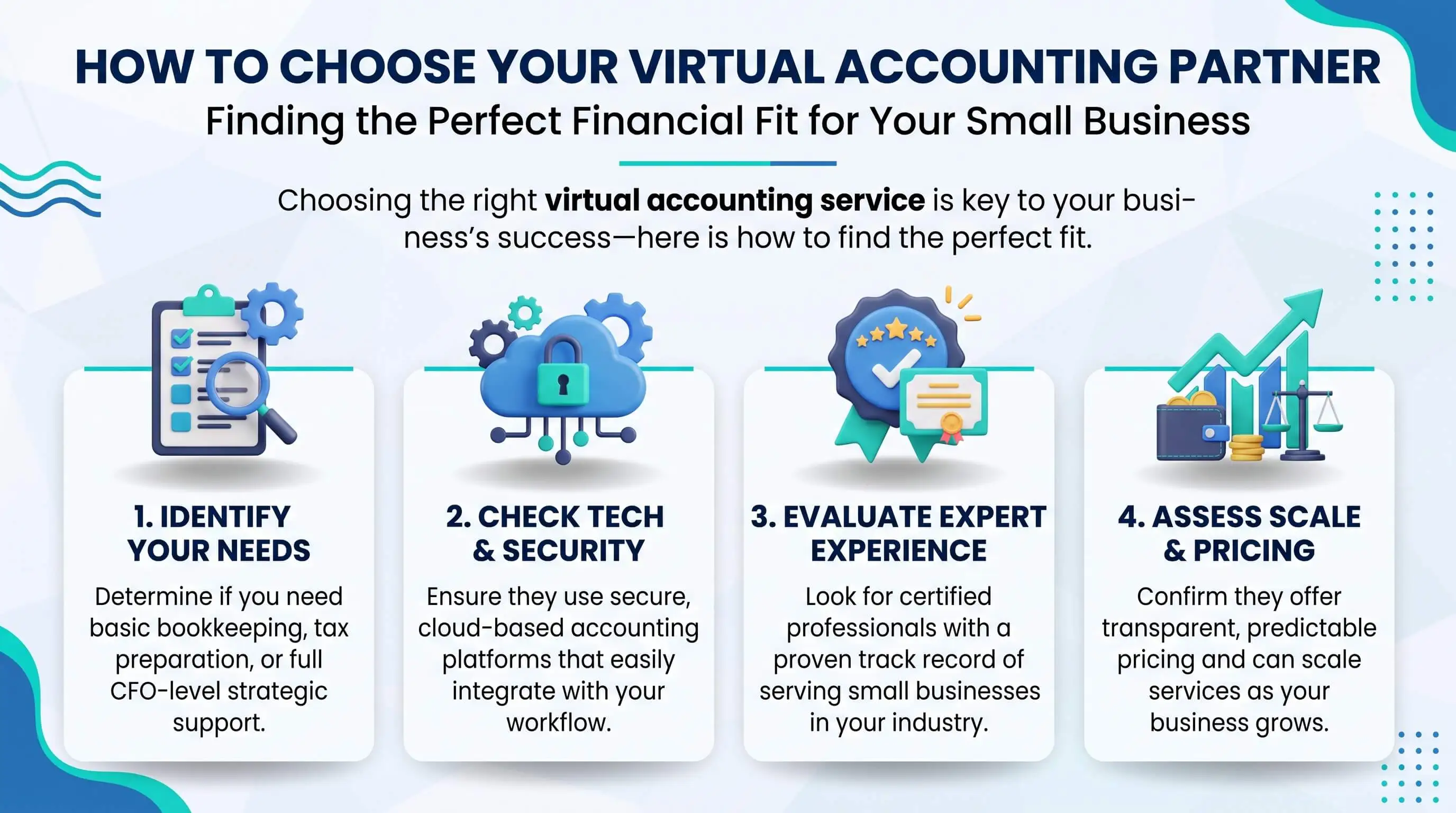
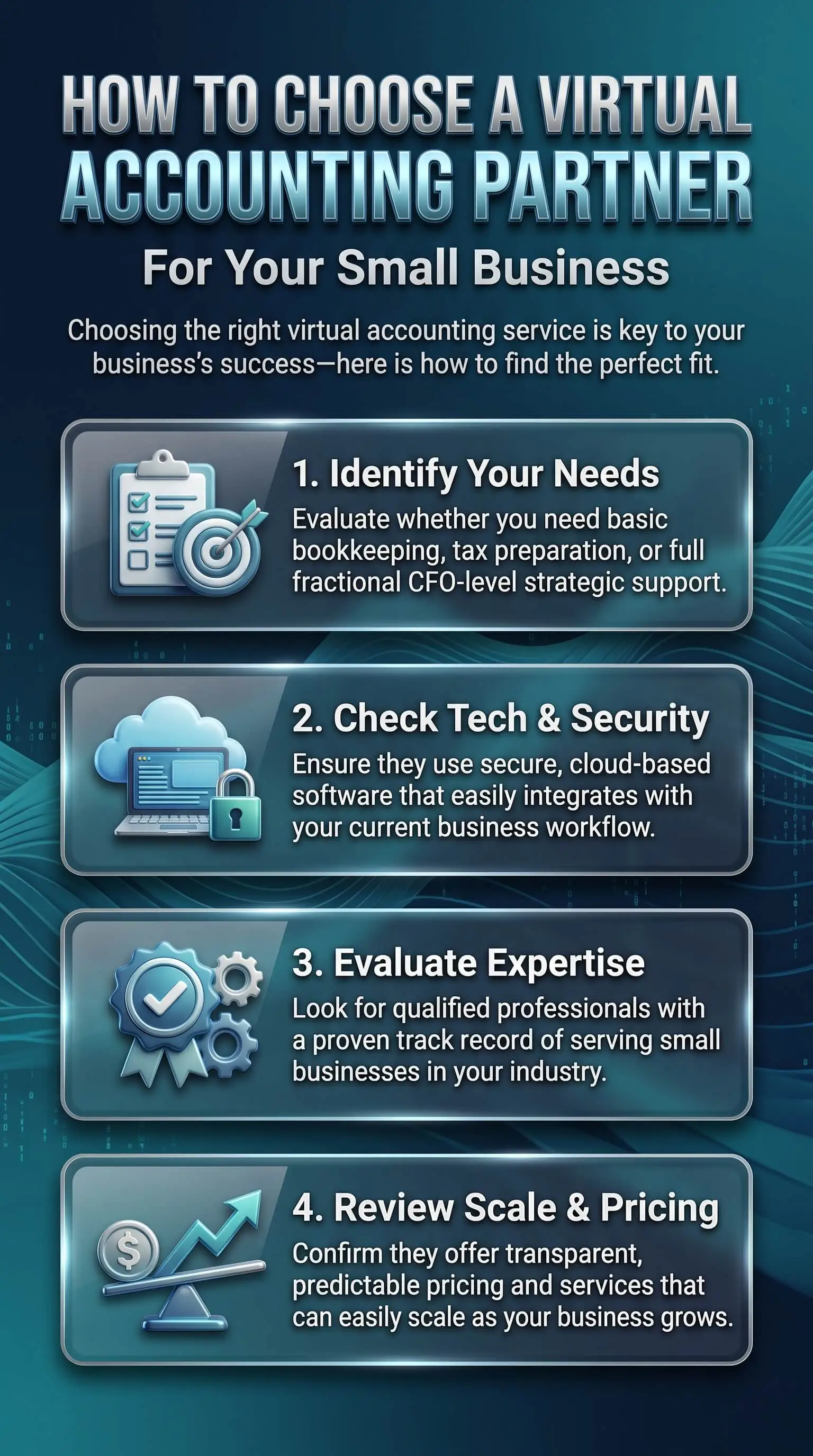
Check fit, expertise, security, and support. Fit covers your stage, budget, and industry, and you'll see expertise in sample reports and references. Security comes down to access controls and data ownership, while support means a named contact and a fixed close calendar.
When Outsourced Accounting Beats an In-House Hire
When you need more than one person's skills but can't justify a full-time salary plus roughly 30 percent in benefits. An outsourced team gives you broader expertise and coverage when someone is out, usually for less than a single hire costs.
Top Takeaways
Pick the tier before the provider.
Bookkeeping for clean records, outsourced accounting for decision-ready reporting, and a fractional CFO for strategy
Get the scope and anything that changes the price in writing
Check expertise with evidence.
A sample monthly report beats a polished proposal
Call at least two references near your size
Favor a team over a single accountant
Treat security as part of the hire.
Individual logins, two-factor authentication, and audit trails are the baseline
Confirm you own your data and can take it with you
Hold support to a date. Your provider should close the books by the same business day every month and review them with you on a call.
Compare against the loaded cost. A full-time hire at the median accountant wage runs roughly $122,000 a year once benefits are included.
What Is a Virtual Accounting Service?
A virtual accounting service is an outside team that runs your books and financial operations in the cloud, so you get accounting support without adding headcount. Most firms sell it in tiers. Pick the right tier first and your shortlist gets a lot shorter.
Bookkeeping covers transaction recording, account reconciliations, and bill processing, which keeps your books accurate and tax-ready. It's the right fit when you mainly need clean records and an easy year-end.
Outsourced accounting adds a full monthly close, custom performance reporting, budgeting and forecasting, and internal controls. Choose it when leadership needs decision-ready reporting and stronger oversight.
Fractional CFO support brings senior financial strategy, cash planning, and help with fundraising or major growth decisions, without a full-time executive salary.
Here's how we explain the difference to clients. Bookkeeping tells you where your money went. Outsourced accounting helps you understand what that means for the business and plan what comes next.
Does the Service Fit Your Business Stage and Budget?
Start with the problem, then find the provider built to solve it. A firm designed for 200-person companies will price and staff like one, and that rarely suits a team of twelve.
In our experience, owners reach out when a few of these start happening at once:
Books close late, or revenue in QuickBooks doesn't match what your CRM says
Reports arrive every month, but none of them help you make a decision
Cash runs tight in months when sales looked fine
A lender, investor, or auditor is about to ask for clean financials
Read pricing closely. A flat weekly or monthly fee is easier to budget, but only when the scope is written down. Hourly billing can work for light needs and gets expensive once volume grows. Either way, ask what falls outside the agreement and what would trigger a price change.
Industry experience matters more than most owners expect. Take creative agencies. Retainers, project-based revenue, and a rotating bench of contractors all call for clean job costing, and a provider who already knows that model will hand you useful reports much sooner than one learning it on your dime.
How Do You Verify an Accounting Team's Expertise?
Credentials get a provider onto your list. They shouldn't be the reason it stays there. Ask whether CPAs review the work and whether the team is certified in your software, such as QuickBooks ProAdvisor status. Then ask for a sample monthly report with client details removed. One actual reporting package will tell you more than any proposal.
References come next. Ask for two from businesses near your size and industry, and call them.
Finally, find out who does the work. A single accountant means one person's bandwidth and one point of failure when they're sick, on leave, or gone. We built Accountix around a team model for exactly that reason, making it a strong fit for organizations looking for an affordable outsourced accounting firm for nonprofits. When someone is out, the close still happens on schedule, and you get specialists in payables, receivables, payroll, and reporting instead of one generalist covering it all.
What Security Questions Should You Ask?
Your accountant will see bank accounts, payroll, and vendor details, so security belongs in the first conversation rather than the contract review. These are the questions we'd want any prospective client to ask us:
Which platforms hold my data, and are they encrypted and cloud-based?
Does everyone who touches my books use two-factor authentication?
Will your team get individual, role-based logins, or will you ask for my password?
Do your systems keep an audit trail of every change?
Can the software vendors you rely on provide SOC 2 reports?
If we part ways, how do I get a complete copy of my records?
At Accountix, we work in encrypted cloud platforms like QuickBooks Online and Bill.com, with strict access controls, audit trails, and two-factor authentication. A provider who hesitates on any of these questions has given you your answer.
What Level of Support Should You Expect?
Every provider promises responsive service. Ask them to put specifics behind it:
A named point of contact and a stated response time
A close calendar that has your books finished by a set business day each month
A monthly review call where someone walks you through the numbers
A written onboarding plan. We bring most clients fully on board within about four weeks of kickoff.
If a provider won't commit to a close date, you'll be guessing at your numbers every month.
Questions to Ask Before You Sign
Bring this list to every intro call, write down the answers, and compare them side by side afterward.
Which services are included, and which cost extra?
Is pricing flat or hourly, and what changes it?
Who will do the work, and who reviews it?
Have you worked with businesses in my industry and at my size?
Can I see a sample monthly report?
By what business day will my books close each month?
How do you handle access, logins, and two-factor authentication?
Which software do you use, and will it work with my current tools?
How long does onboarding take, and what do you need from me?
If we part ways, how do I get my records back?
Red Flags When Comparing Virtual Accounting Services
Vague scope. "We handle everything" usually means nobody owns the close.
No close date. When timing is flexible, your reporting drifts with it.
Shared passwords. A provider that asks for your login instead of setting up its own access is taking a shortcut you'll pay for later.
No references. A firm with happy clients can put you in touch with one.
Lock-in without exit terms. You should be able to leave with every record intact.
"On nearly every intro call, I ask the owner two things: who closes your books, and by what date? Most can name a person. Very few can name a date. That gap usually explains why they called us. When we take over a company's books, the first thing we set up is a close calendar, before any new reports or dashboards. Once owners know we'll finish and review their numbers on the same day each month, they stop second-guessing them and start planning with them. If a provider can't commit to a date on that first call, I'd keep interviewing."
7 Essential Resources
Owners who do some homework before hiring spot a weak provider faster, and they tend to be better partners once the work starts. These are the seven resources we point people to most often.
1. U.S. Small Business Administration: Manage Your Finances
Before you hand off the books, it helps to know the basics yourself. The SBA's guide covers balance sheets and cash versus accrual accounting, and its section on getting accounting help compares CPAs, bookkeepers, and online services. We like its short list of functions someone must own, from receivables and payables to bank reconciliation and payroll, because it doubles as a scope checklist. SBA: Manage your business finances
2. IRS Taxpayer Advocate Service: Small Business Filing and Recordkeeping Requirements
You can't judge a provider's recordkeeping without knowing what good records include. This plain-language guide from the Taxpayer Advocate Service, an independent office within the IRS, lists what small businesses should track, including gross receipts, inventory, and expenses. Small business recordkeeping requirements
3. AICPA & CIMA: SOC 2, SOC for Service Organizations
When a provider says its platforms are secure, a SOC 2 report is how you check. The AICPA explains what these independent CPA examinations cover and why companies that outsource use them to weigh risk. AICPA & CIMA overview of SOC 2
4. Federal Trade Commission: Protecting Personal Information, A Guide for Business
This is the guide we'd want every client to hold us to. The FTC tells businesses to investigate a service provider's data security before outsourcing anything, write security expectations into the contract, and verify compliance instead of taking a vendor's word for it. FTC: Protecting Personal Information
5. NIST: Small Business Cybersecurity Corner
NIST keeps free, practical cybersecurity guidance for small businesses in one place. Skim it before your security conversation with any provider so you know which answers should sound right. NIST Small Business Cybersecurity Corner
6. Intuit QuickBooks: Find a ProAdvisor
If your books live in QuickBooks, Intuit's directory lets you search certified accountants and bookkeepers by location, industry, and service. It's also a quick way to confirm a provider's certification claims. Find a QuickBooks ProAdvisor
7. SCORE: Find a Free Business Mentor
Sometimes the most useful step is a second opinion. The SBA backs SCORE, a nonprofit whose volunteer mentors can help you work out whether you need bookkeeping, outsourced accounting, or something more before you talk to a single provider. Find a SCORE mentor
Vetting an accounting partner works a lot like weighing the cost of hiring an outside agency. You want to know exactly what you're paying for and how you'll tell whether it paid off.
3 Statistics
Cost and risk are where most owners get stuck, so these are the numbers we walk clients through first.
Stat 1: The Median Accountant Earns $83,680 a Year
Source: U.S. Bureau of Labor Statistics, Occupational Outlook Handbook: Accountants and Auditors
Key findings:
The median annual wage for accountants and auditors was $83,680 in May 2025
BLS projects employment will grow 5 percent from 2025 to 2035, with about 115,300 openings each year, so qualified accountants stay in demand
The Accountix perspective: That salary buys one person's hours and one person's skill set. For many of the small businesses we work with, it's more than the budget can carry and still less coverage than the business needs.
Stat 2: Benefits Add Roughly 30 Percent on Top of Pay
Source: U.S. Bureau of Labor Statistics, Employer Costs for Employee Compensation, June 2026
Key findings:
Private industry employers paid an average of $46.89 per hour worked in total compensation in June 2026, and benefits made up 30.0 percent of that cost
For full-time private industry workers, benefits reached 31.5 percent of total compensation
The Accountix perspective: Run the math on a full-time hire at the median wage and the fully loaded cost comes to roughly $122,000 a year, before software, training, or turnover. It's an estimate, but it's the right comparison. When you price an outsourced team, hold it up against that number instead of the salary alone.
Stat 3: Third Parties Were Involved in 48 Percent of Breaches
Source: Verizon 2026 Data Breach Investigations Report
Key findings:
The 2026 report analyzed more than 22,000 confirmed breaches, its largest dataset yet
Third-party involvement rose 60 percent year over year and now appears in 48 percent of breaches
The human element played a part in 62 percent of breaches
The Accountix perspective: Every outside provider you add opens another door into your business. That's a reason to choose carefully, and it shouldn't stop you from outsourcing. Pick a partner that uses two-factor authentication, individual logins, and audit trails, and ask about all of it before you sign.
Final Thoughts and Opinion
We've been cleaning up books since 2015, and one pattern shows up more than any other. The cheapest quote rarely turns out to be the cheapest outcome.
It usually goes like this. An owner hires on price. The close slips a few days later each month, and the reports drift away from what's actually happening in the business. Nobody notices until a loan application or a cash crunch forces the question, and by then the cleanup costs more than the savings ever did.
So our advice is short. Choose the team that will commit to a close date and explain your numbers in plain language. Strong security should be a given with any provider you'd trust with your bank accounts.
A virtual service isn't right for everyone, and we'd rather say so up front. If you need someone on site every week, a local firm may serve you better. Many virtual firms also focus on accounting and reporting rather than tax filing, so ask whether taxes are in scope or whether you'll still work with a separate CPA.
Choosing an accounting partner feels a lot like hiring a marketing agency. The best ones do the work well and leave you better at running the business.
Frequently Asked Questions
How much does a virtual accounting service cost for a small business?
It depends on transaction volume, complexity, and how much of the finance function you hand over. Most firms charge a flat weekly or monthly fee, and a few bill hourly. Accountix outsourced accounting starts at $350 per week, and we set final pricing after a discovery call. Compare any quote against the loaded cost of a hire.
What is the difference between virtual bookkeeping and outsourced accounting?
Virtual bookkeeping keeps your records accurate and tax-ready through transaction recording, reconciliations, and bill processing. Outsourced accounting builds on that with a full monthly close, custom reporting, budgeting and forecasting, and internal controls. Most companies start with bookkeeping and move up as their reporting and oversight needs grow.
Is it safe to give a virtual accountant access to my bank accounts?
Yes, when the provider handles access properly. Look for encrypted cloud platforms, two-factor authentication, individual role-based logins, and audit trails that record every change. Never hand over your own password. Ask whether the platforms they use carry SOC 2 reports, and get the data-return process in writing.
When should a small business move from bookkeeping to outsourced accounting?
Usually when the books close late, numbers disagree across systems, or leadership wants reports it can plan from. An upcoming audit, loan application, or investor review often forces the timing. Outsourced accounting adds that oversight without the cost of building an in-house finance team.
How long does it take to onboard a virtual accounting service?
Timing depends on the state of your books and how many systems need connecting. We fully onboard most Accountix clients within about four weeks of their kickoff call. With any provider, ask for a written timeline and a list of what they need from you, so coverage doesn't lapse during the switch.
Do virtual accounting services handle business taxes?
It varies. Many virtual accounting firms keep your books clean and tax-ready, then work alongside the CPA who prepares and files your returns. Others offer tax preparation as an add-on. Ask each provider exactly what's in scope before you sign, so tax season brings no surprises.
Get Confidence in Your Numbers
Shortlist two or three providers offering remote outsourced QuickBooks bookkeeping services online, and take the ten questions above into every intro call. If you'd like to start with us, book a 30-minute intro call with Accountix. We'll look at where your books stand today and what support would actually help. No sales pitch. Just clarity.